Childhood vaccinations: What is the role of conspiracy theorising?

On Wednesday 26th June 2013, I attended a thought-provoking symposium where international experts in psychology, anthropology and communication sciences came together to describe current trends in public attitudes towards childhood vaccination. The symposium accurately titled ‘Public engagement and risk communication in child vaccination’ was jointly convened by the London School of Hygiene and Tropical Medicine and University of Sydney School of Public Health. The symposium consisted of five talks, ending with a panel discussion. As opposed to giving a specific run down on each of the engaging talks, I will highlight the key messages that I came away with.

The first talk, delivered by Dr Helen Bedford (UCL, Institute of Child Health) presented the determinants of vaccine uptake. She started the talk by presenting statistics from Public Health England, where uptake for the MMR vaccine for children of 12 month is 95.1%. This subsequently dropped to 92.8% at 24 months. However, what is surprising is the range of uptake across the country, which can go from 79.1 to 99.1%. With herd immunity being at 95%, this is an alarming statistic.

Dr Bedford also presented a selection of reasons for this low uptake, gathered from a Millennium Cohort study. For those parents who do not immunise their children, 47% of the reasons were centered on beliefs and attitudes (e.g., believing vaccines overload the system, do not believe in vaccines, etc.). Whereas, for those who partially immunised (e.g., only missing out a few vaccines), only 38% of reasons were centered on reasons of belief and attitudes, and instead it was more centered around practical reasons (e.g., not having the time, clinic is too far away, forgetting, etc.). In all cases, 67% of reasons were conscious decisions.

Dr Heidi Larson (LHSTM) next highlighted the fact that the impact of anti-vaccine information can be rather slow. Rather, an event today does not impact tomorrow. Instead, it is a slow burn, and the impact may come to a head in a year or two down the line. Further, the implications could be all over the world. One claim echoed by Dr Larson, is that if someone does not have access to the internet in a remote village, how will an anti-vaccine claim populated in the UK impact them? Dr Larson responded to this claim by saying it takes only one person to have access to the internet, and then it is word of mouth. Thus, this highlights the different levels of risk management – which can also be linked to conspiracy beliefs more generally and how such information can travel.

Map

A map showing proportion of global vaccine-related reports as positive or neutral. Lighter red indicating more positive

Dr Larson currently explores how information spreads via a variety of methods. One way is via “fast data”, which involves looking at real-time information being spread over the internet. This information is then split into two typologies – positive and negative. If you look at the map above, you can see where the information on vaccines is being spread online across the world, and what typology the information can be defined as. In other maps she showed in her presentation, you can look at a whole country and see the typology of vaccine information being spread online in particular areas. Dr Larson described a scenario, where if an outbreak occurs and the government has a limited budget for communication for vaccinations, you could put a vast amount of resources into a location where there is a lot of negative information concerning the vaccine. As opposed to wasting the resource by directing it somewhere where such anti-information is limited. This is a really interesting possibility, and more information on the project can be found here: http://www.vaccineconfidence.org/

Associate Professor Julie Leask and Dr Hal Willaby (The University of Sydney) then highlighted a variety of sources of vaccine information. One being the GP/family doctor, but they also commented on the rise of the internet. They then went onto discuss a variety of ways to intervene with the vaccine decision process – one being motivational interviewing. As also highlighted in a previous talk by Dr Nick Sevdalis (Imperial College London), parents like to take an active role in the decision process (i.e., decision autonomy). Here, the speakers therefore discuss a respectful and guiding interaction between the health-care professional and parent. Good communication is therefore important in this scenario. If a parent is undecided on whether to vaccinate their child, a bad experience could tip them over the edge.

Finally, Dr Cath Jackson (University of York) and Professor Francine Cheater (UEA) discussed the use of a decision aid. Rather, as with the other speakers, they see the parent having an active role in the decision process to be important. The decision aid they have developed takes the parents though the whole decision process – i.e., discussion both the benefits and the risks of vaccination. It was found in a pilot study that after being given a decision aid, all parents vaccinated their child, as opposed to those given a standard information leaflet about the vaccine, in which only 91% of the parents went on to vaccinate. This does highlight the fruitful use of such a tool on the decision process.

However, as can be seen, conspiracy theories were not highlighted explicitly by any of the speakers. This is not surprising, as research looking at the consequences of conspiracy beliefs is limited – least until my current research as part of my PhD, which aims to empirically explore this. Therefore, I was keen to attend this symposium as I currently have a paper under review, which across two studies demonstrates the impact of exposure to anti-vaccine conspiracy information and one’s vaccination intentions. Thus, for the first time to our knowledge, conspiracy theories have been casually linked with immunisations.

Dangers

In the context of the symposium, the interventions discussed may be fruitful for parents who are unsure of the risk of vaccines. However, for parents who may believe vaccine data is faked for profit by the government, for example, a different approach may be needed. In the panel discussion, I asked the panel their thoughts on the role of conspiracy theorising in the decision process. All were very interested in my research, and agreed that such beliefs would play a role. The topic of conspiracy theories was also highlighted as being an important area of research. Therefore, I feel the discussions relating to conspiracy theories in this domain have only just begun. The symposium was both engaging and enlightening, and I look forward to when my paper is [hopefully] published, thus highlighting the important role of conspiracy beliefs in the decision process, and prompting future discussions on the topic.

We know that for those who do not immunise, 47% of the reasons are centered on beliefs and attitudes. Could conspiracy theorising therefore play an important role in the decision process? My research certainly suggests so.

Posted in Events, Social psychology | 5 Comments

Bilderberg Fringe Festival 2013 special report

Alex Jones at the Bilderberg Fringe Festival

This year, for the first time, the secretive Bilderberg meeting was accompanied by an unofficial Bilderberg Fringe Festival. This consisted of three days of presentations on the alleged evils of Bilderberg, as well as general festivities, all in a field just half a mile or so from the location of the meeting itself, The Grove hotel in Watford, England. As many as 2,000 people filled the site to capacity – many more had to be turned away by event security due to overcrowding. In attendance to give talks were some of the biggest names in conspiracy, including Luke Rudkowski, David Icke and Alex Jones.

Mike Wood and I went along on a Saturday afternoon to meet some of the attendees and find out how they came to believe the Bilderbergers are up to no good. I was struck by the variety of paths that had led people towards conspiracist suspicions, the diverse (and occasionally conflicting) allegations levied at the Bilderbergers, and the various specific crusades people were on – all brought together by shared distrust of the Bilderberg meeting and calls for transparency. I produced a 20-minute audio report of our conversations, which you can listen to below [or download: right-click, save-as].

Continue reading

Posted in Events, World events | Tagged , , , , , | 3 Comments

A trip to the Bilderberg Fringe Festival

Last weekend Rob and I went to the Bilderberg Fringe Festival, a sort of combined protest / music festival organised around the annual meeting of the Bilderberg Group. The Bilderbergers have been the subjects of many conspiracy theories, often involving the New World Order and globalism in some way, and perhaps understandably so – the meetings involve some extremely powerful people, and the goings-on are kept completely secret. While the conference and the festival lasted all weekend, we went on Saturday, when most of the big speakers were on – notably, there was Luke Rudkowski from WeAreChange.org, Alex Jones of Infowars and PrisonPlanet, and the one and only David Icke.

Police watching over the entrance queue

Police watching over the entrance queue

Rob and I arrived in Watford, a nice little English town north of London, in the late morning. There was a considerable presence of police and G4S, who were providing security for the conference, but everything seemed peaceful enough. While waiting in the queue to get in we struck up a conversation with Max North, an occultist and practitioner of white magic. In his twenties and sporting a crystal pendant and an Eye of Horus, Max had some strong opinions about Bilderberg and its connection to occult forces – he says that the Bilderberg group is part of a conspiracy which hates the Earth and nature and wants to bring about a sort of transhumanist cyborg dystopia. This sinister plan comes in part from a larger dark force in the universe, related to David Icke’s lizardlike Archons.

Continue reading

Posted in Events, Uncategorized, World events | Tagged , , , , , | 2 Comments

Robert F Kennedy Jr and vaccines : How even the brightest can fall victim to conspiracy thinking

Robert F Kennedy Jr, famously one of  Robert “Bobby” Kennedy, Sr ‘s 11 children, has made press many times over the last ten years with his staunch anti-vaccination views. In 2005, he wrote an article for Salon.com proclaiming that a government conspiracy was responsible for covering up a link between the vaccine preservative thimerosal and childhood autism. So bad was the article, with considerable factual errors and in the end, scientific fraud on part of the original study, it was retracted completely in 2011.

Despite this, Kennedy has continued to spread his anti-vaccination views, and last week Phil Plait at Slate.com wrote an article demonstrating that even some of the richest, well educated, intelligent and powerful people in the world are not immune from the world of conspiracy ideation.

Since this article has been published last week, the author’s editor received a call from Kennedy himself, which involved an hour long rant highlighting his dismissal of evidence that contradicts him, his cherry-picking of clearly wrong evidence, and the imagination of a vast conspiracy involving the “criminals of the CDC [United States Centers for Disease Control and Prevention]”

What we can see here is that, although we hypothesise that conspiracy theories tend to be more popular with those who have felt a loss of control or power over their lives (and thus both assume that some shadowy group is in control, and attempt to regain that control by exposing them), even some of the richest most powerful people in the world can also become easily influenced by the conspiratorial mindset. We also see evidence of some of the classic cognitive biases at work in the quotation above. In particular, confirmation bias, the idea that we ignore or dismiss evidence contrary to our belief, and we selectively gather evidence to further support this bias.

The article gives us an insight into some of the more vocal proponents behind these types of conspiracy theory, and the dangers of allowing conspiracies such as these to go unchallenged. Kennedy has a unique, instantly recognisable family name, and unfortunately has chosen to instead use his fame and influence to propagate dangerous theories and misinformation. We have often quoted on this blog the dangers in particular of anti-vaccination conspiracies, where parents will withdraw their children from essential vaccination problems based on ‘what they read on the internet’. Although parents have a right to protect their child, we need to be able to give them the tools to reach informed, scientific, and valid answers to their fears and questions, and not allow dangerous, life threatening, otherwise preventable diseases from returning.


Posted in Biases & heuristics, Confirmation bias, What's the harm | Tagged , , , , , , , , , , , , , , , | 1 Comment

Measuring belief in conspiracy theories

On a scale of 1 to 7, do you think JFK was killed by the C.I.A.? The moon landing was faked? The Queen is an alien reptile? That might sound trite, but it’s how most psychological research into conspiracy theories has measured belief. Is this the best way to go about it?

Continue reading

Posted in Personality | Tagged , , , , | 9 Comments

21% of US voters believe Obama is the Anti-Christ : The problem with conspiracy polling

A recent poll by ‘Public Polling Policy’, (despite the name, a private US polling company) conducted an automated telephone poll of 1247 registered US voters and asked respondents a variety of questions about their belief in various popular conspiracy theories. The topline results are available here and are well worth exploring in detail.

The main focus of the research was to measure conspiracy belief across party lines (Democrat vs Republican) as well as to provide a general background measure of conspiracy belief in specific theories. The results were interesting (and sometimes contradictory compared to other polls), but helped to cause many sensational (and occasionally misleading) headlines around the world.

There are several important things to note here when we consider these results. This was a poll of registered voters – an important distinction if we assume that one of the correlates of conspiracy belief, political cynicism/apathy is relevant. If conspiracy believers feel that the world is being controlled by a malevolent group, or that the government is corrupt, they may not be registered to vote as they may feel there is little point. Another distinctive point to make is that conspiracy belief is often seen to be higher among ethnic minorities, whom, especially in the US, may not necessarily be registered voters.

Apart from the potential sampling errors, we have to consider very specifically how these types of questions are asked. Conspiracy theories are multi-faceted and multi-dimensional in their focus, but at their core, boil down to five or six key components. As a result, the wording of a question to discuss a particular kind of conspiracy theory may inadvertently skew results.

A perfect example of this is the question that asks

‘Do you believe aliens exist, or not?’

This does not cover any conspiracy directly. It doesn’t cover governments covering their existence up, denying they exist, or any influence aliens may have over the general population. Many notable physicists and scientists believe in the existence of aliens; it could be considered a statistical hubris to assume we are alone in the universe – but the idea that aliens have visited Earth and/or governments attempt to conceal this is a complete separate belief that is far more closely related to conspiracist ideation.

Perhaps the biggest problem of all is the idea that belief is a binary dichotomous construct. A yes/no response to these questions does not give us nearly enough information to make sensible conclusions, especially when the questions are worded in such a way to only explore a very specific or very general conspiracist idea. The 9/11 question is of particular relevance here. The original question wording was

‘Do you believe the United States government knowingly allowed the attacks on September 11th, 2001, to happen, or not?’

The low results to this question surprised many and perhaps can be explained because most of the conspiracy theories surrounding 9/11 maintain that rather than letting it happen, the government (or corrupt elements thereof) planned and carried out the attacks instead. This is an important ideological and political point and represents a very different type of conspiracy, one which perhaps is more commonly believed. Other polls have often asked questions that relate directly to the government planning and carrying out the attacks, rather than ‘letting them happen’.

So, while the discussion continues about the accuracy of these latest results, and the concern that 21% of voters apparently believe President Obama is the Anti-Christ, it is important to recognise the potential problems and pitfalls about sampling and constructing this type of data without the proper consideration for this complex and often contradictory area of belief.

Posted in 9/11, Round-Ups, Social psychology, What's the harm, World events | Tagged , , , , , , , , , , , , | 2 Comments

28% of US voters believe in a ‘New World Order’ – Infographic

A short post today to bring you a great info-graphic detailing the poll results from the recent Public Policy Polling data. Click to enlarge for the best view!

The United States of Conspiracy

The United States of Conspiracy

Posted in 9/11, Round-Ups, World events | Tagged , , , , | 5 Comments

“The Great Green Con”: Pro-conspiracy information within the media

BEAR

This morning I came across a news article that read so similar to my pro-conspiracy manipulation used within a recent paper, it was quite unnerving. I have spoken about this paper before on this blog, where it was shown that exposure to pro-conspiracy information concerning climate change increased one’s conspiracy belief, which subsequently decreased their intention to reduce their carbon footprint.

This manipulation involved the climate change conspiracy theory being presented, without information refuting it (i.e., “the main-stream account”) being acknowledged. Therefore, the piece aimed to explore the direct impact of being exposed to such conspiracies. Interestingly, the news article here does appear to follow a similar pattern, rather it does not seem to mention the main-stream account to show a balance argument, and when it does, it is in rather a negative light. Further, it includes evidence from scientists, and provides a variety of statistics, all again not counter-balanced, and all again reading similar to my pro-conspiracy manipulation.

ARTICLE

Whilst it is great that these events are discussed, there does need to be some caution. Rather, this article is presented in such a fashion that one’s beliefs (and potentially behaviours) can be influenced without one being even being aware due to the hidden impact of conspiracies, as shown in previous research. Specifically, with this media source having such an impact (e.g., the article has been liked on Facebook over two thousand times already), it should have provided a more balanced argument, and thus being potentially less unfairly influential.

In these blog posts,  I aim to try and highlight the potential consequences of conspiracy theories using real examples, where possible, and also the potential impact of being exposed to such information.  Conspiracy theories are fascinating, but when being exposed to such material in this pro-conspiracy fashion, you need to be aware of the influential nature of exposure to such information, and subsequently actively view it through a more critical eye.

In conclusion: Exposure to pro-conspiracy information has been shown to influence beliefs and behavioural intentions in a lab-setting. Therefore, can being exposed to such information within the media have the same detrimental effects, but in the real world? The experimental research suggests a concerning answer.

Posted in Social psychology, What's the harm | Tagged , , | Leave a comment

Authoritarianism and conspiracy theories – what’s the connection? Is there one?

Although I don’t do it as much as I used to, I still enjoy arguing about conspiracy theories with people on the Internet. As I’m generally pretty skeptical of conspiracy explanations, I usually find myself defending whatever the conventional explanation for something is, and as often as not I get accused of believing without question whatever the government (or Big Pharma, or whoever) tells me. Basically, people accuse me of being an authoritarian, which I’m decidedly not (much to my parents’ dismay).

There has been a lot of psychological research on authoritarianism, much of it by Theodor Adorno and Bob Altemeyer. Some has even concerned conspiracy theories, but as you’ll see, the results are a bit inconsistent. Some studies have shown that people who are more authoritarian are more likely to believe conspiracy theories. For instance, in a seminal study in conspiracy psychology, Marina Abalakina-Paap and colleagues showed that specific conspiracy beliefs tend to be associated with high levels of authoritarianism. Several studies by Monika Grzesiak-Feldman have shown that anti-Semitic conspiracy theories in Poland are more likely to be held by authoritarians. Likewise, a study in the 1990s by Yelland and Stone found that authoritarians are more amenable to persuasion that the Holocaust was a hoax, orchestrated by a massive Jewish conspiracy. Viren Swami, a psychologist at the University of Westminster, has demonstrated that anti-Semitic conspiracy theories are associated with authoritarianism in a Malaysian sample as well.

But there’s some evidence pointing the other way as well. In a separate study, Swami and his colleagues at the University of Westminster showed that 9/11 conspiracy beliefs are associated with negative attitudes toward authority, and John W. McHoskey found that people high in authoritarianism were more likely to be anti-conspiracist when it comes to the JFK assassination.

So what’s going on here? It looks like the content of the theories is what matters. The research on the psychology of authoritarianism has long shown that authoritarians tend to derogate and scapegoat minorities, which seems to be what’s going on in a lot of these anti-Semitic cases: a minority is being blamed by the majority for the ills of society. Swami’s Malaysian study actually proposes that the anti-Semitism shown by the Malaysian respondents might be a proxy for anti-Chinese racist attitudes: there are very few Jews in Malaysia, so Malaysian authoritarians might displace their ethnic aggression from a relatively powerful and socially accepted minority group (Chinese) onto one that is almost non-existent in their society and so can be scapegoated without consequence (Jews).

In contrast, a lot of modern conspiracy theories have a very populist and anti-government tone. They blame authorities for the evils of society, not minorities – the American government blew up the Twin Towers, MI6 killed Princess Diana, and so on. So it makes sense that authoritarians would be less likely to believe that their governments are conspiring against them and anti-authoritarians would find this idea more appealing. There’s no uniform association between authoritarianism and conspiracy belief – it seems to depend on the specifics of the theory in question.

As a side note: there is still some crossover between the anti-Semitic conspiracy world and the more anti-authoritarian theories like the 9/11 truth movement. 9/11 conspiracies are very popular in the Arab world, where there’s also a lot of anti-Semitism. There is also some crossover in the domain of anti-Zionism, which most anti-authoritarian conspiracy theorists seem to adhere to – David Dees is a good example (probably most of his cartoons feature anti-Zionist elements) – but anti-Zionism is not anti-Semitism, it’s just a point on which authoritarian and anti-authoritarian conspiracy theorists often agree.

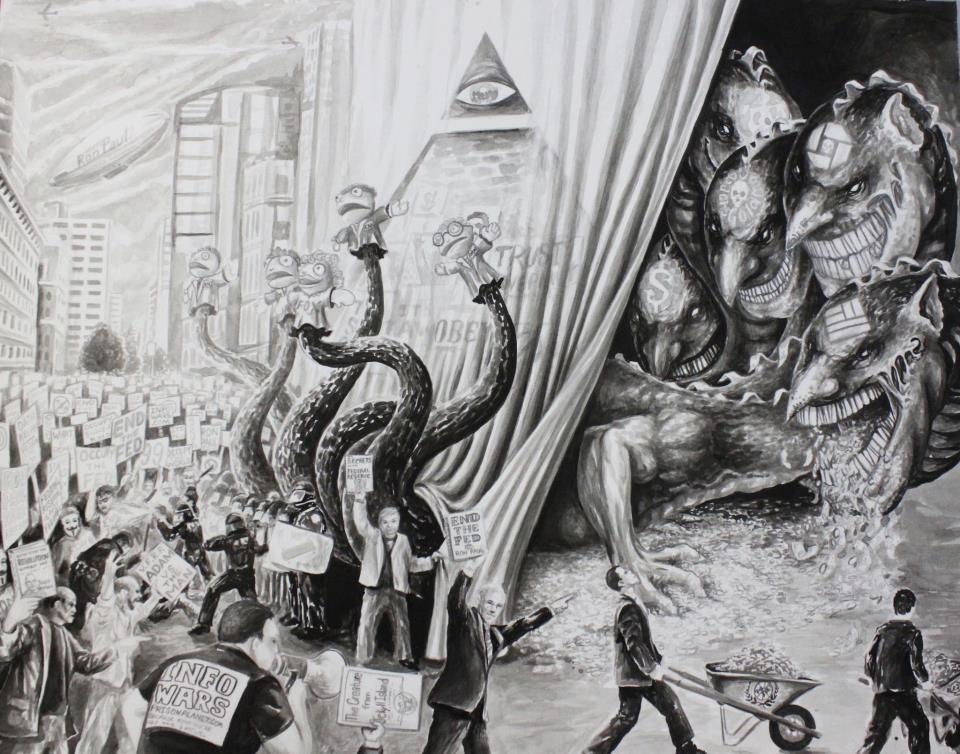
banker-comic

Figures in the crowd like Jesse Ventura and Ron Paul represent the new conspiracism, while the Jewish-caricature bankers are a throwback

Still, antisemitism used to be much more socially acceptable than it is now, and its influence persists in the darker corners of even some modern conspiracy theories. You can see this a lot in editorial cartoons, where conspirators, especially bankers, are portrayed as having exaggerated hooked noses and tentacles straight out of Der Ewige Jude. The artists probably have nothing against Jewish people, but are instead following the conventions of anti-banker propaganda that were first established in the early 20th century, when Nesta Webster was in her prime, the Protocols of the Learned Elders of Zion were still a going concern, and people were generally just really worried that the Jews were up to something.

Posted in Personality, Social psychology | Tagged , , , , , | 22 Comments

Conspiracy beliefs and TV licences: ‘Turning off’ engagement

BBCAs blogged about previously, conspiracy theories are influential and exposure to such theories can influence both beliefs and behavioural intentions in a variety of domains. However, a recent news story caught my attention, as it clearly demonstrated a sense of detachment with legal requirements due to a conspiracy belief.

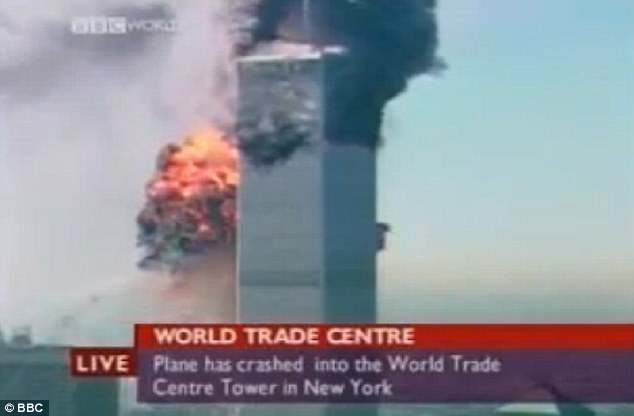
This news story related to a man who refused to pay his TV licence because he believed the BBC covered up facts about the 9/11 terrorist attacks. He commented that he did not want to give money to an organisation ‘funding practice of terrorism’.  This is particularly interesting, as it shows how such a belief can prevent a legal requirement being followed. Rather, a further development to the story relates to him admitting owning a TV and watching it without a licence, as he wanted to keep an eye on what the BBC was showing.

Tower

There can be a variety of reasons for the development of this conspiracy belief, and these have been discussed previously on this blog relating to other types of conspiracy theories (e.g., the monological belief system). However, I wanted to highlight this real world example, as previous empirical research has suggested that conspiracy theory beliefs can affect the societal engagement in several domains. For example, focus groups have shown that parents are reluctant to immunize their children due to endorsing conspiracy theories. This indicates the detrimental effects that may be elicited by endorsing conspiracy beliefs, which has already been discussed in several previous blog posts (e.g., concerning HIV/AIDs conspiracies), and now shown here in this intriguing example.

There are a variety of ways a conspiracy belief can influence a person’s thoughts, beliefs and behaviours.  This example clearly demonstrates one way this can, arguably, negatively influence a person’s societal engagement. Whilst there is still room for empirical research to be carried out to further explore the consequences of conspiracy endorsement, real world examples like these suggest a compelling tale.

Posted in 9/11, Social psychology, What's the harm | Tagged , , | 6 Comments